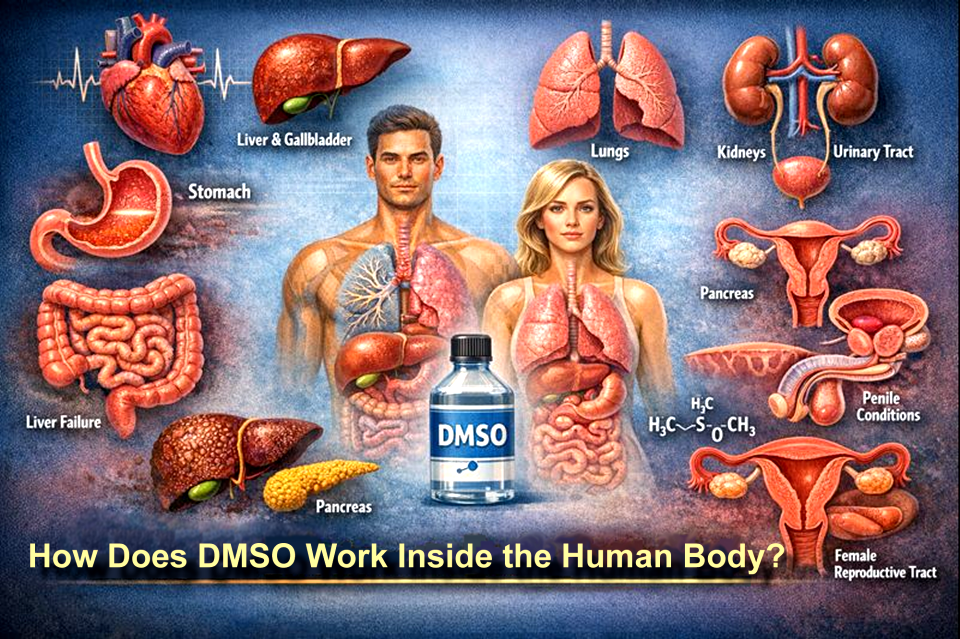
Dimethyl sulfoxide, commonly known as DMSO, is not a typical drug. Rather than targeting a single receptor or symptom, DMSO interacts with the body at a more fundamental level, influencing inflammation, circulation, cellular membranes, and oxidative stress across many tissues at once. This broad mode of action explains why DMSO has appeared in research spanning cardiology, gastroenterology, pulmonology, nephrology, urology, and reproductive medicine for more than half a century. When examined organ by organ, a consistent pattern emerges: DMSO tends to stabilize stressed tissue, reduce secondary injury, and support recovery by improving the internal environment in which cells function. The sections that follow describe how these effects manifest in different parts of the body, offering a system-by-system overview of how DMSO appears to work rather than a catalog of isolated studies.
Heart
The heart is one of the organs most vulnerable to sudden stress because cardiac cells depend almost entirely on a continuous supply of oxygen and energy. When blood flow is interrupted, even briefly, heart tissue can begin to fail. Paradoxically, much of the damage occurs not during the blockage itself, but when circulation is restored. This reperfusion phase triggers oxidative stress, inflammation, calcium imbalance, and mitochondrial dysfunction.
DMSO has been repeatedly studied in this context because it appears to reduce the secondary injury that follows reperfusion. It does so by scavenging highly reactive free radicals, stabilizing cell membranes, and helping preserve mitochondrial energy production. At low concentrations, DMSO has also been shown to influence calcium handling and contractile behavior without disrupting heart rhythm. Together, these effects help explain why DMSO is often described as cardioprotective in extreme stress models rather than as a stimulant or suppressant of heart function.
Stomach
The stomach lining must withstand constant exposure to acid, digestive enzymes, and mechanical stress. When blood flow is reduced, acid secretion is excessive, or inflammation escalates, the mucosa can erode or bleed. DMSO has demonstrated a consistent ability to protect gastric tissue under these conditions.
Rather than simply suppressing stomach acid, DMSO tends to normalize gastric function. In hypersecretory states, it can reduce acidity and volume, while in low-secretion states it generally does not overstimulate. It also improves microcirculation in the stomach lining and reduces oxidative damage, allowing erosions and ulcers to heal more efficiently. This balancing behavior helps explain why DMSO has been explored in stress ulcers, NSAID-induced gastritis, and hemorrhagic gastric injury.
Intestines
The intestines are particularly sensitive to disruptions in blood flow, immune signaling, and oxidative stress. Severe intestinal injury can rapidly lead to systemic inflammation and sepsis. DMSO has shown a strong protective effect in both the small and large intestines, especially during ischemia, shock, and inflammatory states.
DMSO appears to preserve intestinal lining integrity by stabilizing cell membranes, reducing inflammatory cytokine production, and maintaining microvascular blood flow. Importantly, although it interacts with the parasympathetic nervous system, DMSO does not strongly stimulate intestinal motility at typical concentrations, which helps prevent excessive diarrhea. Its tendency to accumulate in colonic mucosa may help explain why it has been studied in inflammatory bowel conditions, where immune modulation and barrier protection are critical.
Liver and Gallbladder
The liver is the body’s primary detoxification organ and is constantly exposed to oxidative and chemical stress. DMSO has been extensively studied for its ability to protect liver cells from toxins, ischemia, and inflammatory injury. Across many models, DMSO reduces lipid peroxidation, suppresses excessive inflammatory signaling, and preserves hepatocyte structure and enzyme function.
Beyond protection, DMSO also appears to support liver regeneration. In cell culture and animal studies, it helps maintain liver-specific functions, preserves glycogen storage, and encourages stem cells to differentiate into hepatocyte-like cells. These effects help explain why DMSO has been explored in both acute toxic injury and chronic liver disease contexts.
In the biliary system, DMSO’s solvent properties become particularly relevant. It interacts with bile chemistry, reduces inflammation of bile ducts, and has been used experimentally to dissolve or soften gallstones when combined with other agents.
Liver Failure
In advanced liver failure, systemic inflammation, oxidative stress, and impaired metabolism dominate the clinical picture. DMSO has been explored as a supportive agent rather than a cure. In limited human observations, it has been associated with improved liver enzyme profiles, reduced vomiting, and better overall tolerance of severe disease.
A critical consideration in this context is alcohol metabolism. DMSO slows alcohol breakdown, which means abstinence is essential if DMSO is used in liver-compromised individuals. This interaction highlights an important theme with DMSO: its benefits are highly context-dependent and can reverse if physiological conditions are unfavorable.
Gallbladder and Biliary System
Gallstones and biliary inflammation arise from altered bile composition, stagnation, and local tissue irritation. DMSO’s ability to dissolve certain compounds and penetrate dense tissues makes it unusual among agents studied for biliary disease.
In experimental and clinical settings, DMSO has been shown to reduce biliary inflammation, improve bile flow, and, when used as a solvent vehicle, assist in dissolving cholesterol-based and pigment stones. It has also been associated with reduced postoperative complications following gallbladder and biliary surgery, likely due to its combined anti-inflammatory and tissue-penetrating effects.
Lungs
The lungs are highly vulnerable to inflammation because even minor fluid leakage or immune overactivation can impair gas exchange. DMSO has been studied in both acute lung injury and chronic pulmonary disease.
In acute settings such as smoke inhalation, shock, or acute respiratory distress syndrome, DMSO appears to reduce inflammatory infiltration, limit pulmonary edema, and preserve cellular energy production in lung tissue. These effects can improve oxygen exchange and survival in severe models.
In chronic conditions, DMSO has been shown to slow fibrotic progression and improve oxygen utilization in some patients. However, while short-term nebulized use has shown benefit in acute injury, chronic inhalation is generally discouraged due to potential tissue irritation.
Pancreas
The pancreas is particularly sensitive to inflammation and microcirculatory failure. DMSO rapidly penetrates pancreatic tissue and has shown promise in both diabetes-related research and pancreatitis.
In diabetes models, DMSO protects insulin-producing cells from immune and toxic injury and supports stem-cell differentiation into insulin-secreting cells. It also enhances insulin responsiveness under glucose stimulation at low concentrations.
In pancreatitis, DMSO reduces edema, improves pancreatic blood flow, and significantly alleviates pain. These effects help explain why it has been studied as a supportive therapy in a condition where conventional options are limited.
Kidneys
Kidneys require constant perfusion and precise regulation of fluid and electrolytes. DMSO has repeatedly demonstrated protective effects in renal ischemia-reperfusion injury, one of the most common causes of acute kidney failure.
DMSO helps preserve filtration, restore urine flow, and reduce oxidative damage following ischemic stress. It also acts as a potent diuretic at certain concentrations, which can be beneficial in conditions involving fluid overload or tissue edema. In autoimmune and amyloid-related kidney diseases, DMSO appears to reduce immune complex deposition and improve renal function in mild to moderate cases.
Urinary Tract
The urinary tract is the one area where DMSO has formal regulatory approval, specifically for interstitial cystitis. In this setting, DMSO reduces inflammation, relieves pain, and improves bladder wall flexibility.
More broadly, DMSO enhances the absorption of medications applied directly to the bladder wall while limiting systemic exposure. This makes it valuable as a drug-delivery enhancer in urology. It has also been shown to reduce bleeding and fibrosis in radiation-induced cystitis and improve symptoms of chronic urinary inflammation.
Prostate
The prostate is notoriously difficult to treat because many medications penetrate it poorly. DMSO’s tissue-penetrating properties are especially relevant here.
DMSO has been shown to reduce inflammation in chronic prostatitis and significantly enhance the penetration and effectiveness of antibiotics within prostate tissue. In cases of benign prostate enlargement, it has been associated with improved urinary flow and reduced nighttime urination, likely due to reduced inflammation and improved local circulation.
Penile Conditions
Certain penile conditions involve fibrosis, inflammation, or impaired blood flow, all of which are challenging to treat surgically. DMSO has been explored for its ability to soften scar tissue, improve circulation, and reduce pain.
In conditions such as Peyronie’s disease, DMSO has shown benefit in a subset of patients by helping remodel fibrotic plaques. It has also been used in severe inflammatory or circulatory conditions where restoring local blood flow is critical.
Female Reproductive Tract
DMSO has been studied across nearly every component of the female reproductive system due to its anti-inflammatory and tissue-preserving properties.
In the ovaries, it protects cells from oxidative and ischemic injury and preserves hormonal function. In the fallopian tubes, DMSO has been used to help resolve inflammatory obstructions, restoring fertility with lower risk than surgical approaches.
Within the uterus and endometrium, DMSO reduces inflammation and fibrosis while improving tissue receptivity. This makes it particularly interesting in endometriosis and chronic endometrial inflammation. In the cervix and vaginal canal, DMSO enhances enzyme activity related to cervical ripening, reduces chronic pelvic inflammation, and alleviates muscle spasm, contributing to improved fertility outcomes in inflammatory conditions.
DMSO Under Review
Across organ systems, DMSO does not behave like a typical drug that targets one receptor or pathway. Instead, it alters the biophysical and inflammatory environment of tissues, reducing oxidative stress, stabilizing membranes, improving microcirculation, and enhancing penetration.
This broad, system-level influence explains why DMSO appears in research spanning cardiology, gastroenterology, nephrology, pulmonology, urology, and reproductive medicine. Its effects are powerful, but also highly dependent on dose, context, and restraint.

Author of DMSO for Humans, Herb Roi Richards, notes that, “DMSO is only considered a ‘drug’ in one single circumstance, and that is for treatment of cysts in the bladder; otherwise, it is a completely natural, herbal substance, that is gaining wider acceptance as a natural remedy for a growing number of ailments.”
Educational context:
This article explains how DMSO appears to interact with different tissues and systems based on decades of laboratory, animal, and limited human research. It is not medical advice and does not imply approval for the treatment of disease.
References & Further Reading
Foundational Reviews & Mechanisms
-
- Brayton, C. F. (1986). Dimethyl sulfoxide (DMSO): a review.
Journal of Toxicology: Cutaneous and Ocular Toxicology.
A comprehensive overview of DMSO pharmacology, membrane effects, anti-inflammatory activity, and safety considerations. - Jacob, S. W., Rosenbaum, E. E., & Wood, D. C. (Eds.). (1971).
Dimethyl Sulfoxide (DMSO).
Marcel Dekker, New York.
Classic reference text covering early clinical, biochemical, and organ-specific research. - Capriotti, K., & Capriotti, J. A. (2012).
Dimethyl sulfoxide: History, chemistry, and clinical utility in dermatology.
Journal of Clinical and Aesthetic Dermatology.
Accessible review of DMSO’s chemistry, penetration properties, and clinical behavior. - NIH PubChem Compound Summary – Dimethyl Sulfoxide (CID 679).
https://pubchem.ncbi.nlm.nih.gov/compound/679
Authoritative chemical and biological profile.
- Brayton, C. F. (1986). Dimethyl sulfoxide (DMSO): a review.
Cardiovascular & Ischemia-Reperfusion Research
-
- Shlafer, M., et al. (1982).
Dimethyl sulfoxide as a scavenger of hydroxyl radicals in ischemic myocardium.
Circulation Research.
Key paper supporting free-radical scavenging in heart tissue. - Cottrell, J. E., et al. (1984).
Protection of myocardium by DMSO during ischemia and reperfusion.
American Journal of Physiology.
- Shlafer, M., et al. (1982).
Gastrointestinal Tract (Stomach & Intestines)
-
- Abdel-Salam, O. M. E., et al. (2004).
Dimethyl sulfoxide reduces gastric mucosal injury.
Pharmacological Research. - Jacob, S. W., et al. (1983).
Prevention of stress-induced gastrointestinal ulceration with DMSO.
Annals of the New York Academy of Sciences.
- Abdel-Salam, O. M. E., et al. (2004).
Liver & Biliary System
-
- Santos, N. A. G., et al. (2008).
Dimethyl sulfoxide protects against drug-induced liver injury.
Toxicology. - Abdel-Zaher, A. O., et al. (2007).
Protective role of DMSO in hepatic ischemia-reperfusion injury.
Journal of Biochemical and Molecular Toxicology.
- Santos, N. A. G., et al. (2008).
Lungs & Acute Respiratory Injury
-
- Gursoy, S., et al. (2006).
Protective effects of DMSO on lung injury after trauma and shock.
Journal of Trauma. - Yamashita, C. M., et al. (2009).
Dimethyl sulfoxide attenuates acute lung injury.
American Journal of Physiology – Lung Cellular and Molecular Physiology.
- Gursoy, S., et al. (2006).
Pancreas (Diabetes & Pancreatitis)
-
- Kobayashi, T., et al. (1995).
Protection of pancreatic tissue by dimethyl sulfoxide.
Pancreas. - Zhang, Y., et al. (2010).
DMSO-induced differentiation of stem cells into insulin-producing cells.
Journal of Endocrinology.
- Kobayashi, T., et al. (1995).
Kidneys
-
- Hoyos, M., et al. (2009).
Dimethyl sulfoxide protects against renal ischemia-reperfusion injury.
Transplantation Proceedings. - Abdel-Rahman, M. K., et al. (2005).
Renoprotective effects of DMSO in oxidative stress models.
Nephron Experimental Nephrology.
- Hoyos, M., et al. (2009).
Urinary Tract & Prostate
-
- FDA – RIMSO-50 (Dimethyl Sulfoxide) Prescribing Information.
https://dailymed.nlm.nih.gov
Official FDA-approved indication for interstitial cystitis. - Perez-Marrero, R., et al. (1988).
Intravesical dimethyl sulfoxide therapy for interstitial cystitis.
Journal of Urology.
- FDA – RIMSO-50 (Dimethyl Sulfoxide) Prescribing Information.
Reproductive System
-
- Mancini, R. E., et al. (1977).
Protective effects of DMSO on reproductive tissues.
Fertility and Sterility. - Various Russian and Eastern European clinical reports (1970s–1990s)
Exploring gynecologic, urologic, and fertility-related applications of DMSO.
- Mancini, R. E., et al. (1977).
Regulatory & Safety Context
-
- Mayo Clinic – Dimethyl Sulfoxide (Intravesical Route).
https://www.mayoclinic.org
Patient-oriented safety overview. - Annals of the New York Academy of Sciences (1983).
DMSO Symposium Proceedings.
Multidisciplinary discussion of benefits, risks, and unanswered questions.
- Mayo Clinic – Dimethyl Sulfoxide (Intravesical Route).
The references above include review papers, clinical reports, and experimental studies that together illustrate the breadth of DMSO research. Inclusion does not imply regulatory approval for any specific use.
Leave a Reply